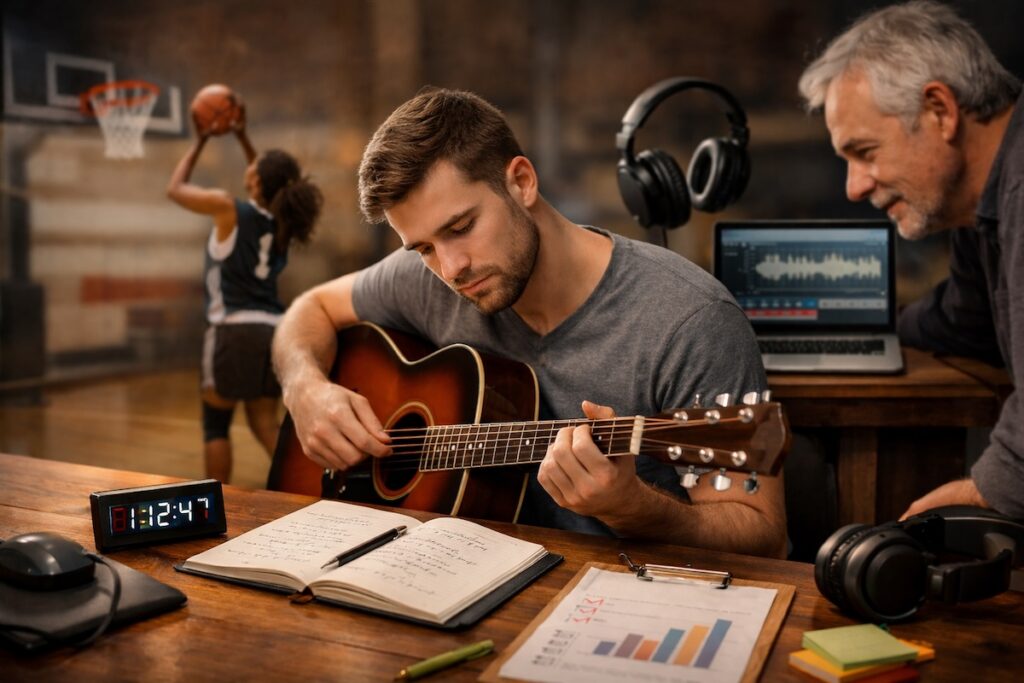
Have you ever made progress slower than you wanted? You might feel that you’re putting in more time and effort than the next person, but you can’t seem to get ahead. Science suggests that the road to becoming an expert is found through deliberate practice. Scientists believe that this is all that’s required to become an expert in any field. (Check out The role of deliberate practice in expert performance: revisiting Ericsson, Krampe & Tesch-Römer (1993)
The way in which you practice can have a much bigger impact on your results than how much you practice. Natural talent isn’t considered important within this learning model (it certainly helps, but research shows that it is not required).
Use deliberate practice to master any skill:
- Deliberate practice must be deliberate. Deliberate practice starts with a plan and has a goal. You might choose to focus on driving to the basketball goal with your left hand or work on your minor chord changes on the guitar. Randomly shooting baskets or strumming the guitar while watching commercials isn’t deliberate.
- Divide your goal into sub-skills. Consider what you want to achieve and then determine the skills necessary to reach that goal.
- Track your practice. Avoid relying on your memory to track your practice. Use a notebook, spreadsheet, or other means to record your results. Then review your practice session and make your plan for your next session. Spend a few minutes on this.
- The better your plan, the faster you’ll progress. Avoid the trap of working mindlessly. Have a plan and continue to strengthen that plan.
- Find a way measure your skill. If you’re mastering an instrument, record yourself and listen. If you’re practicing your 3-point shot, determine your percentage of success.
- Be smart. Deliberate practice, even in small doses, can be much more effective than endless, mindless practice. Avoid believing that you must practice 8+ hours per day to see significant results.
- Focus on practicing as intelligently as possible, and then worry about how much time you’re putting into it.
- Turn off all distractions. Turn off your electronic devices during your deliberate practice.
- Practice near the limit of your capability. You’ll get the best return on your time investment if your practice at the point you make regular errors. Correcting those errors is vital. You don’t learn much while doing things that are easy for you.
- If you’re constantly making mistakes, pull back a little. If you’re just learning to speak Russian, taking the equivalent of a PhD level course won’t be useful.
- Keep a regular schedule. Experts believe the maximum amount of deliberate practice that can be completed in a day is 4-5 hours. If you can do more than this, you’re probably not practicing deliberately. You can read about, The Power of Persistence: Keep Going Even When It’s Tough.
- Limit your sessions to 90 minutes, or until your focus starts to wander. Use multiple sessions to reach a maximum of hours per day.
- When I was younger and learning how to play the trumpet in the 3rd grade, I had to practive 30 minutes every day!
- Seek a mentor. Until you’re an expert yourself, you can’t accurately determine all of your mistakes. You also won’t know the best way to correct them. Find a great mentor and use them effectively. A mentor might come as a coach, or a teacher, or consultant – whatever the title, find someone that has the expertise and has acommplished what you want to do. While you might not be able to have a mentor present for every moment of your practice, spend as much time with them as possible.
Give deliberate practice a chance for a month. Resolve to practice at least one hour each day for the next 30 days. Practice deliberately and stretch yourself. You’ll be amazed at the improvement you enjoy in one, short month.
Many people know about the Ultimate Blog Challenge – It starts Jan 1 and I will be writing for the next 30 days! If you are not a part of it, come join us!
Welcome back Paul! I can really use some of your deliberate practices in my re-organization projects. I do some of them but will follow through more thoroughly now. This is also great for getting back on track to my daily walking. If I don’t have a plan I seem to get off schedule and say, “I’ll walk tonight or tomorrow.” Once I get off track I’ve lost my momentum. No better time to start then the beginning of a new year.
Thanks, Martha! I am with you on scheduling. For me, if I do not schedule a class at the gym, I won’t go. Knowing that I am committing to it means I am going to show up.
I guess I need to work on figuring out why I do not want to go workout on my own… But that is another topic for another day!
Happy new year, Paul!
I like this post. Progress makes so much more sense when it’s tackled in a structured, measurable way rather than just putting in more hours. Deliberate practice turns effort into actual results.
I like the word you used, Tamara – MEASURABLE – if we track something, we can measure it. THe is no use in doing something if it doesnt’t help us in one way or another (unless it is something fun that we want to do!)
Thanks for stopping by!
Paul.
These are some great tips, Paul!
I also had music lessons (piano) and ugh! I was not fond of practicing – but put in those steady 30-60 minute bits …
Then- we had a new HS choir director – and I ended up as one (of two) girls’ choir accompaniests… I had a terrible crush on our young teacher(fortunatly, unrequited!!) and I was MUCH more diligent about practicing! And, yes, my playing improved!!
When I took up the folk harp in my 40s, I read that in harp school ~ 500 AD, students played up to 5 hours daily in the little dark huts . So, I often put in 3+ hours of an evening …. the harp came much easier, and I try to get in rehearsing a couple of days a week.
Wow, Nadya! What a story!
My dad was a composer/conductor and a professional musician. He was the reason we “had to” practice so much. In the beginning, i did not like it at all. However, I kept with it all through college!
These days, I just play the radio – (not even… I stream my music!)
Thanks so much for the motivation to practice this year. I’m going to practice writing blog posts and commit to writing one per day this month.
happy to be there to motivate you on, Amanda!
I’ve been learning French for almost 6 years but I still can’t speak it, I’m going to try this deliberate practice with my French learnings. Thanks for the inspiration!
Magnifique, Kimberly!
When I was a wee little one, I went to pre-school at Lyceum Français Kennedy, a french school in NYC. I do nto remember any of it. So sad.
Deliberate practice = putting in the work. While we want to believe we can become an overnight success, that doesn’t happen. The tips you provided are a great reminder of what it means to put in the work.
This reminds me of the girl in Willy Wonka, “But I want it nooooooowwwww, Daddy!” GOod things come to those that wait (and put in the work!)
Thanks for stopping by, Kim!
When I was learning to play piano in grade school, it was just me, the piano and a metronome. Focus and purpose. Sadly, I haven’t played in decades and lost the skills. Bit that is what it takes.
You can always go back to it! (at least that is what I tell myself too!) I played trumpet all the way through college!
A very helpful post for me, Paul. I have not been doing deliberate practice. I have no plans. I tend to just fly by the seat of my pants. Now I ave a plan to be more deliberate, at least for this month.
It is also being more mindful when you are deliberate and plan things out! Thanks for coming back, Lily!
I love this! This puts everything in a different perspective. The recording of our practice is something I have not done and I am going to put that into practice this year. Thank you for your wise guidance.
P.
You are welcome! Thanks for reading!
Happy New Year Paul! I love this perspective of deliberate practice. I am on a mission of being more intentional with how I spend my time this year. These tips are helpful as I work more on being consistent.
Glad it helps, Jennifer! No need to do them all, find one or two and see if they work for you. Then, you can add more.
I want to make my focus better for the new year… Consistency is key and how better than having deliberate practice in plcae!! I deliberately and intentionally do time blocks and task batching to manae my time better. A modified version of pomodoro technique keeps me involved and active on deliberate practice.
Your 8 points here are really inspiring and gives me ideas on how I can streamline my own methods… Thank you for this post, Paul!