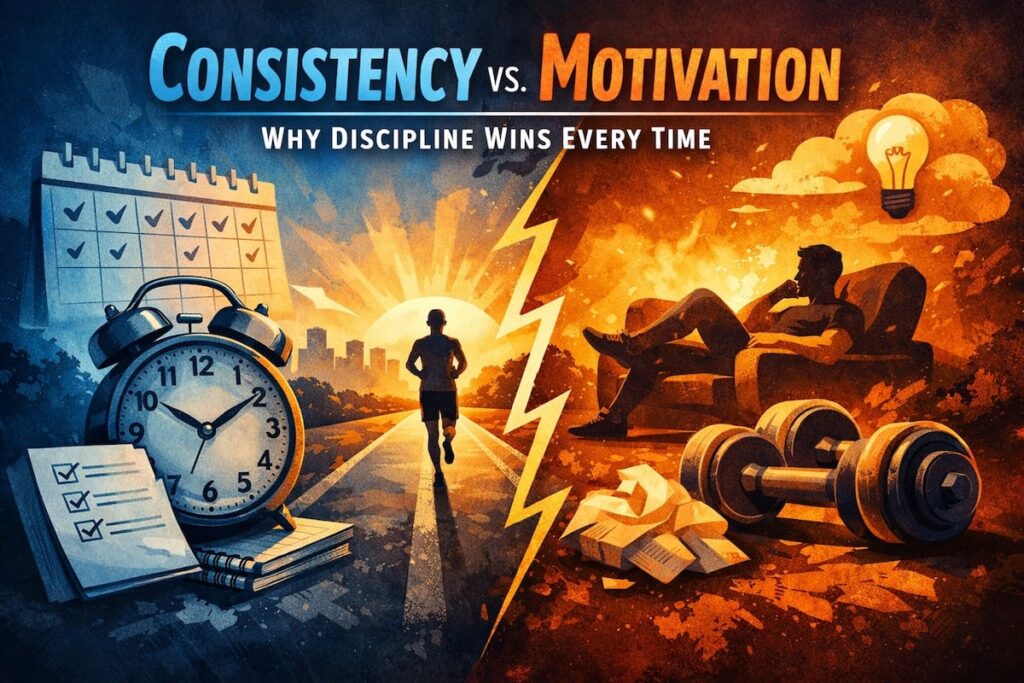
If you’ve ever started something with a burst of energy and then watched that energy disappear a week later, you’re not alone. That’s the real tension behind Consistency vs. Motivation. Motivation feels amazing when it shows up, but it never signs a long-term lease. Consistency, on the other hand, can actually build a life. Right now, at the start of the new year, people are coming up with all sorts of New Year’s Resolutions that will not succeed (I say that not as a Debbie-Downer, but based on research!)
Motivation is the spark. Consistency is the engine.
When motivation is high, it’s easy to begin. You get excited about a new project, a fitness plan, a creative habit, or a business goal. The early progress feels effortless, almost automatic. You think, This time I’m really going to stick with it.
Then a normal day arrives. Life happens. Family member have demands/request of you and suddenly your plans start to crumble.
It is not a catastrophe. Just one of those days where you slept a little less, the schedule fills up, something unexpected pops up, and your brain feels overwhelmed. These are the days when motivation disappears. And when motivation leaves, the only thing left that can carry you forward is discipline, which is what makes consistency possible.
That’s why, in the debate of Consistency vs. Motivation, discipline wins every time.
Motivation is emotional. Discipline is a decision.
Motivation depends on your feelings, and feelings are inherently inconsistent. Even the most driven people have days where they’re not excited, not focused, and not feeling it. It happens to everyone.
Discipline doesn’t require excitement. It requires a choice.
Discipline is the quiet commitment you make in advance. It’s saying: “This matters to me. So I’m doing it, even when I’m not in the mood.” That’s not harsh. It’s not punishment. It’s simply deciding you’re going to follow through.
When you rely on motivation, your goal becomes optional. When you build discipline, your goal becomes part of your identity.
Consistency vs. Motivation: What actually creates results?
If motivation created results, everyone would be in shape, financially stable, and writing their book. Motivation is common. Results are not.
Results come from consistency.
And consistency comes from what you do on the days you do not feel inspired.
This is the part people rarely talk about. Most of the important work in life is boring in the middle. That’s true for fitness, business, relationships, writing, learning a skill, and building your reputation. The middle is where it stops being new. The middle is where you have to show up without the emotional reward.
That’s where consistency beats motivation.
Consistency builds trust with yourself
One of the best benefits of consistency has nothing to do with productivity. It has to do with self-trust.
Every time you follow through on something you said you would do, you build a little more confidence in yourself. You prove to yourself that your word matters. You become someone you can rely on. And, if you can’t rely on yourself, who can you rely on?
This compounds fast.
A single day of discipline might not change much. But a month of it starts to change how you see yourself. A year of it can change your life.
The opposite is also true. When you wait for motivation, you create inconsistency. And inconsistency quietly erodes self-trust. Not because you missed a day, but because you start believing the story that you don’t follow through.
Consistency changes that story.
The hidden cost of waiting for motivation
Waiting for motivation sounds harmless, but it creates a constant mental negotiation:
- “Should I do it today?”
- “Do I have enough time?”
- “Will I feel more ready tomorrow?”
- “What if I don’t do a good job?”
That negotiation is exhausting. It drains energy before you even start.
Discipline removes the negotiation. It turns the decision into a default.
Instead of asking, “Should I?” discipline says, “This is what I do.”
The real secret: systems make consistency inevitable
The goal is not to become a robot with unlimited willpower. The goal is to build a system that makes consistency easier than inconsistency.
That’s how you win the Consistency vs. Motivation battle in real life: you stop relying on feelings and start relying on structure. You have to plan for it. You have to do something to make it happen.
A few simple systems that work:
1) Choose a specific time.
“Someday” is not a time on the calendar. Set an actual time: Monday through Friday at 7:30am. Or every day after lunch. Or every evening at 8:45 pm. Maybe you rely on a class schedule and work it into your own schedule. That is what I do with going to the gym.
2) Reduce friction.
If it takes ten steps to begin, you will resist it. Make the first step incredibly easy. Shoes by the door. Notebook open on the desk. The document already pulled up.
3) Make the minimum tiny.
Tell yourself, “I only have to do five minutes.” You’ll often do more, but even when you don’t, you protect the habit.
4) Prepare your environment in advance.
Discipline becomes easier when “future-you” is supported by “past-you.” Set things up the night before.
This is how consistency is built – it is built by design, not by willpower.
Why discipline wins every time
Motivation is a great spark, and I’m grateful for it when it shows up. But motivation cannot be your plan.
In the end, Consistency vs. Motivation isn’t really a competition. Motivation starts things. Consistency finishes them. And discipline is what makes consistency possible. It is a combination fo both that makes a great team.
If you want real progress this year, don’t aim to feel inspired every day. Aim to build a simple system you can follow on your worst day.
That’s where the growth happens.
If this resonated with you, leave a comment and tell me what you’re working on right now and what system could help you stay consistent this week.
Well for the next few days I’ll be in Virginia visiting my daughter so while the motivation is with me, not sure if the consistency is since I probably won’t be walking everyday. I just hope I can get back in my routine when I get back.
In my 70s, I’ve been fascinated learning about ways ADHD / autism manifest in women, and ways we mask….. oy! (And especially enjoy short vids – yep… yep… yep!)
My daughter used to tease she’d make me a t- shirt, “ask me about……” (the current passion)
If I’m interested, I can hyperfocus for hours, and continue doing something for years … health /well being stuff like making yogurt (weekly), doing qigong, offering massage for over 40 years (with the accompanying laundry) …
if I’m not interested, it can be hard to dredge up the energy! Executive function is iffy…
And there’s a strong “out of sight, out of mind” factor.
I have various tools, inc putting things i have to do on my calendars. Bite size bits help, and lists.
My SoulCollage facilitator training starts Sunday, so this week I’ll be chipping away at storage for supplies in my Atelier
This is so helpful! I am constantly caught in the negotiation of motivation. The two most important things to me right now are eating all meals made at home and exercising every day for the month of January (I joined a January challenge with a video for each day) so, I am working to build systems around them.
I have a busy day and evening ahead of me today so yesterday I made sure there were leftovers from lunch and dinner so I didn’t need to make food today. The system isn’t there yet but this is a small piece of what I can do to support future-me.
Thanks so much for this!
Wonderful goals! I’ve been eating whole foods most of my life, and living on the West Coast, have access to lots of loan and organic. My daughter, a middle granddaughter and I hope to get to ballet this afternoon!
Nadya
This blog post definitely resonates with me. As a stroke survivor who has resulting communication challenges I have struggled to find the key to success. For me, having a consistent schedule helped. I didn’t wait for the motivation to hit me, I knew that I needed to do things every day to move forward. Two specific things you wrote are so important for me. “Motivation is emotional. Discipline is a decision” And “Waiting for motivation sounds harmless, but it creates a constant mental negotiation:”
My word for 2026 is RESOLVE because of this very thing. While my vision holds fewer things, what is there is far more consequential than I have ever had before, and staying the course is key to each of them. And what you brought out about trust is so key. When we break trust with ourselves, it is so hard to regain it, and it affects our overall belief in what is possible for us. I’ve started thinking about honoring something. Whatever it is I have said will be important to me – I need to have practices that demonstrate to me and to others that I honor that. Be it health, relationships, our work, whatever it might be. We need to be less concerned with what others expect of us and more focused on what we expect for and from ourselves. Good insights.
I have seen the benefits of consistency myself – and showing up even when I’m not motivated is it’s own win in itself too.