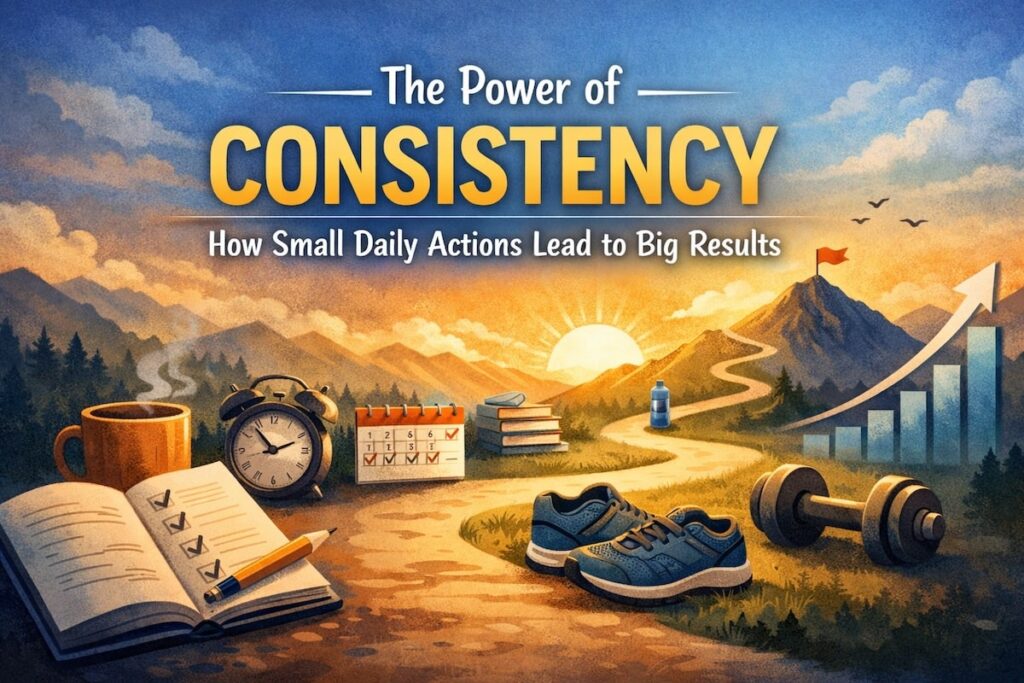
Most of the things we call “success” look flashy from the outside. The BIG before-and-after photo OR a big launch of a new product or website,, when you get a promotion, or you finally write the book you have been working on for years.It’s easy to assume there was a single turning point that made it all happen. There was something that really kicked your butt into gear,
But in reality, it usually isn’t one big moment.
It’s a bunch of ordinary days. Wach day seeing little “massive” progress.
Consistency is one of those ideas that sounds almost too simple to matter, and yet it’s the difference-maker in nearly every area of life (kinda like compound interest!) There are a lot of things I can think of off the top of my head that are like this:
- Getting fit.
- Building a business.
- Improving a skill like playing a musical instrument or getting better at a sport
- Working on your relationship.
- Building confidence to be a public speaker
The people who get where they want to go are often the ones who keep showing up, day in, day out, especially when nobody’s cheering and nothing looks impressive yet.
Consistency is where the “compound interest” happens
Here’s what makes consistency so powerful: it compounds.
One workout doesn’t transform your body. One blog post doesn’t build an audience. One healthy meal doesn’t change your health. One practice session doesn’t make you great at guitar, sales, or public speaking or anything else I listed.
But the little bit of constant improvement that day that matters… It is the tenth one that matters. The fiftieth times matters. The three-hundredth matters.
When you repeat a small action long enough, it starts stacking. Progress becomes less like a straight line and more like a curve that slowly bends upward. At first, it feels like you’re doing a lot and getting very little back. Then, at some point, things begin to click. Your energy improves. Your skills sharpen. Your confidence grows. Your results show up in ways that surprise you and suddently you notice big improvements.
It’s not magic. It’s momentum. It didn’t happen one particular day, it happened over time.
And the frustrating part is that the early days rarely look like momentum. They look like effort with no reward. That’s why so many people quit right before things start changing.
Consistency builds habits, and habits reduce friction
One reason consistency works so well is that it builds habits. When you commit to something regularly, your brain starts to automate it. The first few times you do a new habit, it feels heavy. You have to convince yourself that it is worth it to do, over and over. You debate it. You negotiate with yourself like you’re trying to close a deal.
Then, when you repeat it over and over, the process gets simpler. You stop needing a big motivational speech in your head. You just do the thing.
That’s the real win: consistency reduces the mental effort required to start.
If you’ve ever had a stretch where you wrote every morning, exercised after work, or reviewed your finances every Friday, you know what I mean. At first, it’s a project. Later, it’s just part of who you are. The action becomes normal. I like to say, “It is who you Be.”
And once something is normal, it becomes sustainable.
This is why small daily actions can be so effective. Ten minutes of writing. Ten pushups. One sales outreach message. One paragraph. One page. A short walk. A few minutes of planning your day. None of it looks dramatic. But it’s exactly the kind of action you can keep doing, and that matters more than any single “super” effort.
The hardest part: staying steady when results are slow
The main reason people struggle with consistency is simple: results are delayed. We live in an instantaneous word. We wnat things NOW. THink about this… Do you get annoyed when you order get a product onilne and it takes 10 days to get to you?!?! I remember the TV commercials for items to call now to get your bonus for whatever product it was. The last screen always had the small print that it would take 8-10 weeks to get the item. We were HAPPY with that! But now, practices by Amazon, etc. that get things delivered sometimes as soon as the next day have spoiled us! Again… I digress.
Your brain wants proof that what you’re doing is working. It wants a scoreboard. It wants a reward. And when the reward doesn’t show up quickly, you start questioning everything.
“Is this even making a difference?”
“Shouldn’t I be further along by now?”
“Maybe I should do something else.”
“Maybe I’m not cut out for this.”
That mental spiral is normal. It doesn’t mean you’re failing. It means you’re human.
In those moments, it helps to remember that consistency doesn’t mean perfection. It means persistence.
Skipping a day doesn’t erase your progress. Giving up does.
If you miss a workout, you don’t become “someone who doesn’t work out.” If you miss a writing session, you didn’t lose your ability to write. You simply missed a day. The best move is almost always the same: return to the habit as quickly as possible and keep going.
One of the most underrated skills in personal growth is learning how to restart without drama.
No guilt. No big reset. No “I’ll start over on Monday.” Just: “Okay. Back to it.”
Focus on the process, not the outcome
Outcomes matter, of course. Goals are useful. But consistency thrives when your attention is on the process.
The process is the part you control.
You can control whether you show up today. You can control whether you take the small step. You can control whether you do the minimum version of the habit when you don’t feel like doing the full version.
You cannot control exactly when the big result will appear.
So instead of measuring your progress only by what you see in the mirror, in the bank account, or in your analytics dashboard, try measuring it by your follow-through.
“Did I show up today?”
“Did I keep the promise I made to myself?”
“Did I do my small daily action?”
That kind of scoring system keeps you moving even when results are lagging. And results almost always lag.
In the long run, consistency beats intensity
We love intensity because it feels productive. It feels like a breakthrough. It feels like a movie montage.
But intensity is hard to repeat.
Consistency is repeatable.
A person who works out moderately five times a week will get better results than someone who goes all-out once a month. The same principle shows up everywhere:
- The business owner who does small, steady marketing actions each day will outperform the one who does occasional “big pushes.”
- The learner who practices a skill a little each day will outperform the one who crams once in a while.
- The writer who writes consistently, even in small amounts, will eventually have a body of work.
The steady, repeated effort always wins because it keeps you in the game long enough for compounding to do its job.
Your next step: choose one thing and start
Here’s the beautiful part: you don’t need a perfect plan. You don’t need a massive time commitment. You don’t need to overhaul your life.
You need one small daily action you can repeat. Think of something that is so “doable” that you can still do it on busy days, low-energy days, and imperfect days.
In the comments answer these two questions:
- What is one thing you want to do consistently?
(Example: walk for 15 minutes, write 10 minutes, stretch daily, reach out to one prospect, practice a skill, drink more water, read 5 pages.) - When will you start?
(Be specific: “today,” or “tomorrow morning at 7:30,” or “Monday, January 5.”)
Pick one. Start small. Then show up again tomorrow. Lather. Rinse. Repeat!
I’m enjoying your blog series on consistency Paul. My answers to your questions are #1 – get back on a routine to walk 3 miles per day. #2 – I have already started, I walk (with Snowball) every morning and I’ll be added the evening walk also. Walking around my block is just about a mile so it’s easy to get 3 miles, I just need to stay consistent because once I miss a day, it’s hard to get back at it.
I know how that feels when you skip a day.. It then becomes easier to skip another, and another, and so on. And sometimes even if it is a day or two, getting back into the routine is hard – I especially feel this when I miss a workout.
Thanks for sharing!
After the Holidays, I definitely need to get back on track to eating clean and reaching my modest daily fitness goals. Everyday life alone will be a big factor helping me along the way, because there is so much consistency in routines.
Your life always seems so busy anyway, Tamara! I find that making small, conscious habits helps. For example, when I am out and about, it is easy for me to want to stop for fast food or something super-processed. However, I stop and think about how soon I can get to home and eat good food.
Keeping it consistent is key! Thanks for stopping by!
Similar to Tamara’s plan, I need to get back to eating food made at home. Both my health and my wallet will thank me if I do. So, the plan is to start today with making simple lunch and dinner.
Ah yes – those times when it doesn’t seem like anything is happening… but of course, it is. I heard someone ask: When we plant a seed in the ground, would we dig it up every day to see if anything had changed, or would we have faith that it would show up as a plant in its time? That stayed with me. Buried results aren’t missing; they just aren’t visible yet.