If you read my earlier post, The Magic of Deliberate Practice, you know I believe that progression is built from the consistent practice of small decisions.
I’ve learned this the same way most of us learn it: by trying hard, showing up, and still feeling like I should be further along. That “I’m doing the work… why am I not improving faster?” feeling.
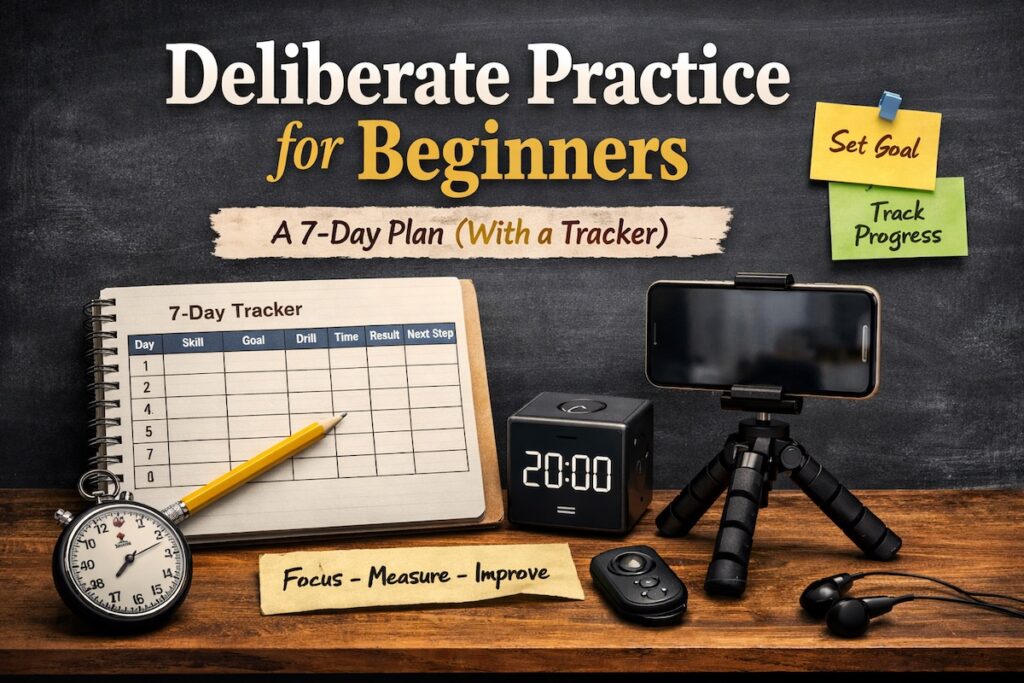
This post is what I use when I want a practical reset. It’s a deliberate practice for beginners in a simple 7-day plan. It is a simple method to track your progress. You can use it to help plan a focused week where you can prove to yourself that improvement is something you can create on purpose.
Before You Start: Choose One Skill for the Week
The biggest mistake I see (and I do this too) is trying to improve too many things at once. If you want the week to work, pick one skill and stay with it for seven days.
Pick something specific you can practice in short sessions. Here are a few examples that you can try:
- Give a clear 30-second introduction when you meet someone new
- Write a stronger first paragraph for your blog posts
- Improve your phone photos by focusing on framing and light
- Speak more clearly on calls by slowing down and reducing filler words
- Cook one simple meal better (consistency is a real skill)
Once you choose, commit to do it for 20 minutes a day. If you only have 10 minutes, do 10. The key is focus and consistency , not duration.
The 7-Day Plan for Deliberate Practice for Beginners
Day 1: Define “Better” and Take a Baseline
Today is about clarity. You need a micro-goal that you can measure.
Examples of micro-goals:
- “Record my 30-second intro and reduce filler words to one or fewer.”
- “Write 150 words and remove vague phrases until every sentence says something real.”
- “Take 15 photos of the same object and choose the best 3 based on framing and light.”
Today’s work: Do one attempt and write the result down. This is your baseline. You are not trying to be amazing today. You are getting honest data.you need to know where you are starting from if you are going to figure out how to get to your destination.
Day 2: Break the Skill Into One Sub-Skill
Most people practice the whole thing. Deliberate practice isolates the part that has the biggest payoff.
Sub-skill examples:
- Introductions: your first sentence (the opening)
- Writing: the first 3 lines, or your transition between paragraphs
- Photos: light first, subject second
- Speaking: pace and pauses
Today’s work: Choose one sub-skill and practice only that. You are building one strong brick, not painting the whole house.
Day 3: Slow It Down and Clean It Up
I’ve noticed something about myself: when I rush, I can’t see my mistakes. When I slow down, the mistakes show up clearly, and I can fix them. (Sidenote: I was watching “The Mystery at Blind Frog Ranch on HBO Max (or whatever the current name is) and the episode was about Cave Diving. One of the phrases they used was, “Slow is Smooth and Smooth is Fast.” That is a good mantra for this – go slower, you can see mistakes and clean them up and the whole process will be faster.)
Today’s work: Practice at half-speed. If you’re speaking, slow your pace. If you’re writing, revise slowly and cut anything that feels fuzzy. If you’re doing photos, take fewer shots and set up each one intentionally.
Day 4: Add One Constraint
Constraints force better decisions. They also keep practice from turning into autopilot.
Constraint examples:
- Introductions: one take only, then rewrite it using fewer words
- Writing: no adverbs allowed for one paragraph
- Photos: only 10 shots, so each one has to be intentional
- Speaking: record yourself and aim for calm, steady pacing
Today’s work: Add one constraint and measure your result again.
Day 5: Get Feedback (Even If It’s Just You Reviewing You)
Feedback is where the growth accelerates. A coach is great, but you can still get meaningful feedback by recording yourself and watching like a friendly, honest editor.
Today’s work:
- Record your attempt (voice or video) – If you want, check out this Portable and Flexible Tripod from Amazon Basics – you can use to set up your phone and record yourself!
- Review it once and write down one specific improvement
- Repeat the attempt with that single improvement in mind
Keep it to one improvement. One lever at a time. Again, don;t do too much at once.
Day 6: Test Day
Today you do a clean attempt and compare it to Day 1. This is the day I like, because it shows me the truth. Even small progress becomes obvious when you track it.
Today’s work: Do one full attempt, measure it, and write down how it improved from your baseline.
Day 7: Lock It In and Choose Next Week’s Focus
This is where people usually drift. They feel a little progress, then life takes over. I’ve done that more times than I can count. So now I end the week by making the next step stupid simple.
Today’s work:
- Write what worked best this week
- Write what still needs work
- Choose one small adjustment for your next 7-day cycle
- Decide your minimum plan (example: 10 minutes, 3 days a week)
The Tracker (Google Docs Version)
I made this tracker simple on purpose. If it’s complicated, you will not use it. This will take you about a minute to copy from my Google Docs.
7-Day Deliberate Practice Tracker – Click the link and you can copy the Google Doc (you wlil not be able to edit the link, so you can copy it).
Final Thought
For me, deliberate practice is a way to get my confidence back. Not the hype kind of confidence. The quiet kind that comes from evidence.
If you do this for seven days, you will not just “learn about” deliberate practice. You’ll feel what it’s like to improve on purpose.
If you try this plan, I’d love to hear what skill you picked and what changed by Day 7. For now, leave a comment below and tell me what you might plan on practicing this week.
Thank you for this thought provoking post, Paul.
My immediate thought is to incorporate it into the month long SoulCollage facilitator training that starts Sunday!
I’m already beginning the immersion, by starting a couple of journals, and setting up my physical space…
I’m working on clearly presenting the focus of the process (I’ll revisit the ‘elevator speach’ I wrote for our October challenge!) So will likely work on #1 this week!
Thanks again
Nadya, this made my day. I love that you’re stepping into the SoulCollage facilitator training with that kind of intention already, journals open and space set up and all. And yes, revisiting your October elevator speech is such a smart move, because that clarity at the front end makes everything else easier to build.
If you focus on #1 this week, you’ll be doing yourself a real favor before the training momentum really kicks in. I’d love to hear what you land on as your simplest, clearest way of describing the process when you revisit it.
Thank you again for reading and for sharing what you’re working on.
Be Well.
Paul
What a great plan and thank you for showing the daily steps to follow. I find that by focusing on one thing at a time, it’s easy to learn or complete.
Focusing on one thing keeps you focused for you, and for me too!
Thanks, Martha!
I enjoyed reading this. The 7-day structure makes deliberate practice feel approachable instead of overwhelming
I like how it is manageable and easy to do. It is small enough to be doable, and just right to start making changes!
Thanks, Tamara!
I am reworking the intro to my podcast, not just what I say but how I say it. I think this will be my focus for the week.
I had to request access to the google sheet, even as a viewer. I’m looking forward to using it, thanks for creating something for us readers!
You should be able to make a copy of it via the link, Kimberly (Unless I did something wrong – always a possibility!)
I think the section on constraints is what sets this apart. Those are a necessary part of reality.
Glad you liked it, Kathi!