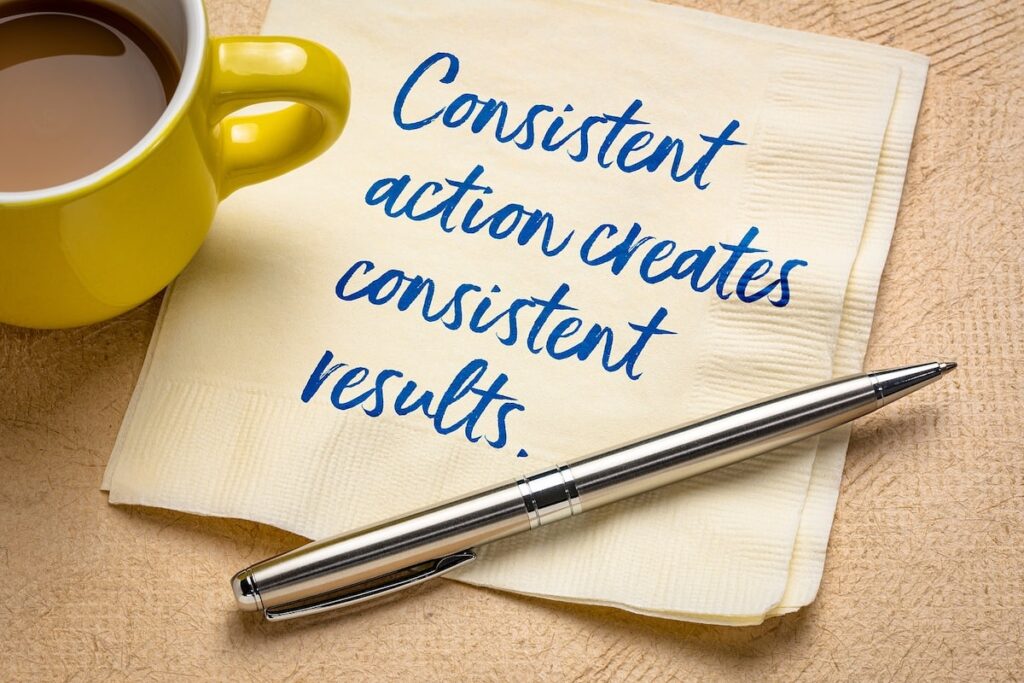
If I could bottle one “success secret” that actually holds up in real life, it would not be hustle, hacks, or heroic motivation. It would be consistency.
Not the big bang type of activity. The quiet kind. The kind that looks almost boring on Tuesday and then becomes undeniable by the time a few months pass.
I put together a Top 10 list of lessons on consistency because I see the same pattern everywhere, in health, learning, relationships, and business. Mainly, I see it in myself. There are weeks where I feel unstoppable, and weeks where I feel like I am pushing a boulder uphill while answering emails, handling client needs, and trying to keep my own goals moving forward. What saves me is never a sudden burst of inspiration or sheer will power. It is the decision to show up again.
This is the overview post. Each lesson will eventually become its own deeper post, with tools and examples you can steal.
1) Small daily actions create big results
Success rarely shows up because of one action. I am sure you have heard about the overnight success that took years to get there! Success shows up as a string of “small enough to do” actions that compound.
I think about this every time I work on a website project. The big transformation is impressive, but the real work is the steady process: updates, tweaks, improvements, checking the basics, then repeating. It is not glamorous, it just works. Sometimes when I have a call with my coach, and we talk about my wins, I just say that it was another slow and steady week where stuff just got done.
You can read more details about this over at: The Power of Consistency: How Small Daily Actions Lead to Big Results.
2) Motivation is helpful, but discipline is dependable
Motivation is a mood. Discipline is a commitment.
I have had mornings where I felt excited to write and mornings where I wanted to do literally anything else. The days that mattered most were not the motivated days. Those were the days I did what I had to do anyway, even if it was ten minutes, even if it was messy. That is discipline doing its job.
3) Consistent habits create momentum
Momentum makes everything easier. When you are in motion, you stop negotiating with yourself every day. There is a reason why it is a Law of Physics: A body in motion, tends to stay in motion. (And as my HS Physics teacher would say, “And, ah.. that’s the chapter.”)
One of the best shifts I have made is treating certain actions as “default,” not “optional.” When something becomes part of the rhythm, it stops consuming mental energy. That is when progress speeds up. I have been consistently taking AG-1 Greens every morning for many months now. SOmetimes I wake up and I just want my coffee. However, I know I need to start my day with my green drink before my coffee, so I do.
4) Repetition is not boring, it is how the brain learns
There is a real science behind consistency. Repetition strengthens the pathways in your brain. Over time, the work requires less effort because your brain gets more efficient at doing it.
This is why practice changes everything. When you repeat the right small actions, you are not just doing the work, you are becoming the kind of person who does the work.
5) Consistency beats perfection every time
Perfectionism is sneaky. It pretends to be “high standards,” but it often shows up as a delay.
I have watched people hold back because their plan was not perfect, or their first attempt would not be amazing. Meanwhile, the person who is willing to be a beginner wins, because they keep learning in public and improving in motion. I have a client that talks about something being a B+ and getting it out the door. I love this! There is no need for the perfect A+! Done is better than perfect!
6) How to stay consistent when you feel like quitting
This is where the real game is played. A few things are worth repeating:
- Remember your why. Get back to the deeper reason.
- Make it smaller. If you cannot do the whole thing, do the first tiny step.
- Add accountability. Tell someone. Make it real.
- Celebrate progress. Small wins keep the engine running.
- Accept imperfect effort. A “half day” is still a day you showed up.
Some days, “consistent” looks like doing the minimum. That is fine. The win is staying in the arena. Sometimes you just have to “push though it” – I call this willpower to get it done. This is not the best for a long-term change, but it will get you through the day/week. Using the list above will help make the change last longer.
7) Treat consistency like a superpower
Consistency is ordinary actions with extraordinary patience. It is the extra that makes ordinary become extraordinary.
The key is building systems that make showing up easier. Put it on the calendar. Prepare the environment. Reduce friction. Then stay flexible when life happens. The goal is not rigidity, it is persistence.
8) Consistency creates stability and clarity
When life feels chaotic, it is often because there are no anchors. Consistent routines become those anchors.
Even a few steady touchpoints, a morning plan, a daily walk, a weekly review, knowing that you go to a specific spin class each week, can reduce stress. And in work, consistency builds trust. People remember who reliably follows through.
9) Consistency outperforms intensity
Intensity is exciting and exhausting. Consistency is quieter and far more effective.
A burst of effort might impress you for a weekend. A steady rhythm changes your identity. If you are trying to build something that lasts, consistency is the strategy. As mentioned before, willpower (i.e., intensity) is not long-lasting. It will lead to burnout. Keep it slow and steady, and of course, consistent, and you will be on the right track.
10) In the digital age, consistency must be sustainable
The online world rewards people who “show up,” but it also burns people out.
Sustainable consistency looks like realistic schedules, batching content, automating what you can, and protecting rest. The goal is to keep delivering value without sacrificing your health or your creativity.
The big idea
Consistency is not about perfection. It is about returning. Again and again. Over and Over (just like Madonna’s song). And also, it is the Chumbawma song, “Tubthumping” where they sing:
And on that note, literally…. If you want, leave a comment and tell me which of the ten lessons you want as the first deep-dive post. I will write that one next, and I will include a simple tracker you can use immediately.
Be Well.
Paul
Love it! Yes… Consistency in small things leads to big results. The ever faithful compounding effect. It’s true for both sides of the coin. Consistently ignore something – you won’t feel it the first few times, but eventually, that shows up bigger as well. So getting consistent about what builds up our work and ourselves is key. I also appreciate that you talk about sustainability in this because, all too often, we start with a list of things we want to be consistent about. And the key is first choosing what consistently matters. I’ve started using the rule of three: what three things will I do each day for my health, my business, my writing, etc.? Picking my three is what makes it sustainable and eliminates decision fatigue in my day.
Thanks, Kathi!
The compounding effect of every decision is always present, regardless of the outcome. Every choice you make is like flipping a coin – you never know how it may turn out. Your Rule of Three is such a smart way to make consistency sustainable and cut decision fatigue (I may borrow that?!). Prioritizing what really matters helps you avoid the trap of trying to be involved in everything.
Thanks for sharing!
What a super list Paul! You’re making it easy to be consistent. I especially like number 2 and 6 plus they both work on my walking and writing.
Hi Martha – Glad you think it is easy to be consistent! I am trying to help!
I appreciate #10 combined with the Big Idea that follows it: returning again and again to sculpt new patterns of consistency into our brains. For me, self-compassion, forgiveness and a growth mindset nurture consistency. Thanks for the thought-provoking post!
The key is to NOT burn out, Audre! Good luck with it all!